
As I write this piece, India has just concluded a gruelling election schedule across five states, with West Bengal completing its final phase of voting on April 29. While both phases of polling in Bengal–with 90% plus turnout in each, broke records in independent India, this election may also be remembered for something far more layered: people did not step out merely to choose their representatives–they stepped out to secure themselves.
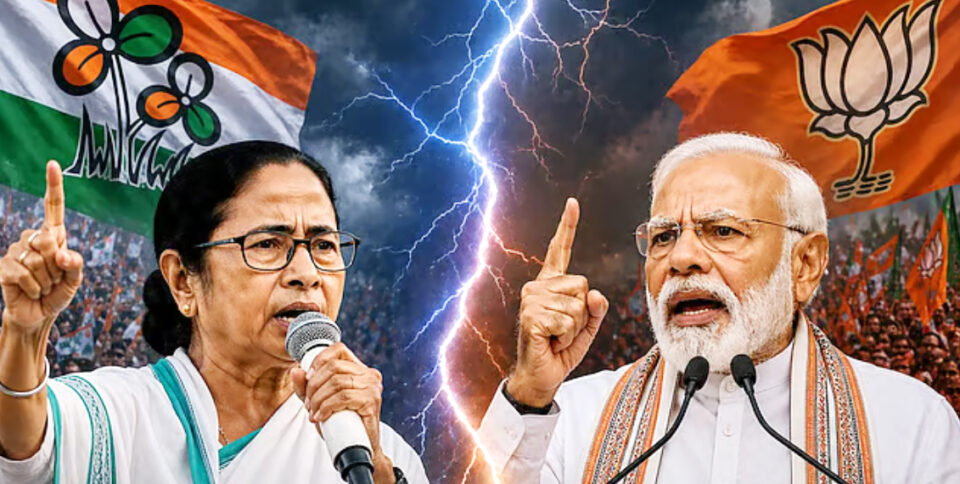
As the heat shifted from polling to the authenticity of exit polls before the actual results, Bengal remained the hot cake of the current assembly elections. The results may re-seat Mamata Banerjee for a fourth time as the CM or give way to the Bharatiya Janata Party’s first government, but for those who travelled into Bengal, walked its streets, spoke to its people, and listened–not just heard–the election was never only about who would occupy the Chief Minister’s chair.
It was about something far more fundamental.
The Question That Followed Me
Of the five states that went to polls, it was evident–even to a casual observer–that Bengal had become the centrepiece. But why?
Before the first phase of Bengal elections on the 23rd April, I carried this question with me from Delhi, and I expected political and obvious answers–incumbency, opposition momentum, ideological battles, etc. Instead, from the airport queue to the bylanes of Murshidabad, Malda, and other constituencies dominated by Muslim, tribal, and rural populations, to the more urban and elite constituencies of South Kolkata and Diamond Harbour–from cab conversations to tea stalls–the answers I received resisted neat political framing.
As I boarded the plane to Kolkata, behind me at the boarding gate stood a young family: a man, his wife in a burqa, and their three-year-old son dressed in a carefully arranged tuxedo, adjusting his bow tie with visible pride. They were first-time flyers, travelling on emergency tickets–costly, unfamiliar, but “extremely necessary”. Their destination was not tourism or work. It was voting, and they needed to reach home in time.
Across trains and flights, this pattern repeated itself. Labourers, professionals, students, entire families–returning, not casually, but urgently and anxiously. Tickets were inflated, journeys were uncomfortable, and yet there was a shared determination that seemed to override all practical barriers.
India has seen high voter participation before, but not like the one Bengal witnessed in this election–ever in the electoral history of independent India since 1952. But this election for the Bengal Assembly did not feel like participation alone. For many, it felt like compulsion born out of uncertainty, panic, and anxiety–and for others too, these elections were different in more ways than appeared.
The Anxiety Beneath the Turnout
Special Intensive Revision (SIR) was definitely a big issue. Conversations inevitably turned to electoral rolls. The frustration, anguish, helplessness, and sentiments of dejection, fear, and insecurity due to deletions of votes running into lakhs–with nearly 27 lakhs deleted votes, were precise, not perceived–and the effect was real.
People spoke of names missing, of “logical discrepancies,” of fear that eligibility itself had become unstable; about fears like, “What if I am deleted permanently and remain no longer a citizen?”; anxiety over “what will happen to those who are never included–where will they go? Will they be able to access state benefits? Will Aadhaar cards still be valid? Will they hold Indian passports, ration cards?”–and an endless stream of such questions.
The fear of exclusion gripped so hard that even those who confirmed their names online did not appear reassured. It became compulsive to vote this time–to be reassured that they existed as voters, to reaffirm their inclusion in the electoral rolls. They travelled anyway. They stood in line anyway. Because the act of voting was no longer sufficient in itself–it had become evidence, documentation of citizenship. This, in spite of assurances from Election authorities, who have maintained that revisions to electoral rolls are a routine administrative exercise aimed at ensuring accuracy, with mechanisms in place for correction and appeal. Yet, on the ground, this assurance did not always translate into confidence.
Under Article 326 of the Constitution of India, the right to vote flows from citizenship. It is a constitutional guarantee grounded in adult suffrage. But in the Bengal elections of 2026, that relationship appeared inverted. Voting was not merely an outcome of citizenship–it was becoming a way to assert it.
The indelible ink mark on the finger was no longer symbolic–it was archival. People photographed themselves, posed with inked fingers, preserved it–keeping proof that they had voted, that they existed within the rolls, that they belonged.
Beyond Party, Towards Positioning
On the surface, the election presented familiar contours: three terms of incumbency, opposition expansion, ideological polarization. There was visible dissatisfaction with the ruling establishment in pockets, including among those historically opposed to the BJP.
Yet, as polling progressed, something shifted—gradually, calculatedly, and very consciously.
This was not a wave election in the conventional sense. Nor was it a fragmented multi-cornered contest. Instead, what emerged was a quieter, more calculated consolidation–what many described, sometimes reluctantly and sometimes aggressively, as a vote for the “lesser evil.”
For some, this meant strategic alignment against the BJP, driven by concerns over representation and ideological space. For others, particularly within segments of the Bengali middle class–the bhadra samaj–it meant navigating discomfort with the incumbent while questioning the alternatives.
The decision-making process was layered, almost introspective. It was not just about governance records or campaign rhetoric. It was about proximity, familiarity, and cultural belonging.
Talking to those on the roads–cab drivers, jhalmuri vendors, labourers, and small shopkeepers–the divide in many of my interactions appeared vertical. Several respondents who identified with migrant or Hindi-speaking backgrounds, many of whose families have lived in Bengal for generations, seemed more receptive to narratives around Hindutva and “ghuspaithia.” In contrast, among many native Bengali-speaking communities–across both Hindu and Muslim groups–these issues appeared less central, particularly among non-elite sections.
Reflections from interactions with sections of academia, civil society, and urban professionals suggested a clearer position on the “ghuspaithia” issue, “cross-border illegal migration was an issue till the 1980s, not anymore. Moreover, if there is any illegal crossing through the India-Bangladesh border, it is the responsibility of the Home Ministry to identify and take suitable measures. This is clearly the job of the central government, which is well-equipped to check illegal migration and secure the borders.”
Thus, the “ghuspaithia” issue, which was supposed to be a major talking point for the Bengal election appeared to fade and gradually gave way to concerns around SIR deletions and, more importantly, to what Bengal is known for, its food (especially maach), culture, language, and identity. Campaign imagery–such as staged fish-eating pictures–was often viewed with scepticism and, in some cases, pushed away Bengali sentiment.
A Bengali Hindu professor of economics at a prestigious college in Kolkata appeared visibly upset over her exclusion from the electoral roll when she said, “Let us take a stand in this election for Bengal.” She was not a lone voice. Many appeared worried, with some going as far as to describe this Bengal election as “the most unconstitutional election in the history of India”, a characterisation that reflects the depth of anxiety, even if it remains a matter of debate.
A retired Supreme Court judge, who had never voted while on the Bench out of propriety, found himself a victim of “logical discrepancy.” “Bengal is different”, he said. “Logical discrepancy is most unsuitable for this land, where within a single household you may find Mukhopadhyay, Mukherjee, Mookherjee, or Bandhopadhyay, Banerjee, and Banerji as surnames representing the same family,” was a commonly echoed sentiment.
Who Represents Bengal?
As conversations deepened, a different axis of the election became visible: Who is Bengali enough? Who understands Bengal–not as a constituency, but as a lived reality?
These questions were not always articulated directly, but they were present–in pauses, in hesitations, in choices. Language mattered. Accents mattered. Cultural fluency mattered. Food, literature, roots–these are not peripheral markers; they are central to political legitimacy.
Symbolic gestures, like fish-eating images, were closely observed, often sceptically. Attempts to perform cultural belonging did not always translate into acceptance. There was a discernible resistance to what many perceived as external imposition or superficial adaptation. Bengal, as it often reminds, was not ready for easy assimilation into uniform narratives.
Federalism, Identity, and Unease
Running parallel to these conversations was a broader unease–less visible, but persistent. Discussions around centralisation, including proposals like ‘One Nation, One Election’, were interpreted by some not merely as administrative reform but as indicative of a larger tendency toward uniformity. Whether or not such interpretations hold policy weight, their political impact was evident.
India’s constitutional framework, anchored in the Preamble, promises unity while preserving diversity. The balance between the Union and the states–though not explicitly described as “federal” in the text–has been affirmed as part of the Constitution’s basic structure.
In Bengal, this balance was not being debated in courtrooms–it was being negotiated in everyday conversations. There was a clear assertion: identity, language, and cultural specificity are not negotiable.
Institutions Under Quiet Scrutiny
Alongside identity and representation, institutional questions surfaced repeatedly. What is the role of the Election Commission of India? Is it merely administrative, or does it carry a deeper responsibility of safeguarding trust?
Under Article 324 of the Constitution of India, the Commission is entrusted with the ‘free and fair’ conduct and supervision of elections. Its authority is expansive–but so is the expectation of neutrality and procedural fairness. Concerns over voter list revisions, timing, and accessibility of grievance mechanisms raised questions that extend beyond a single election cycle. They touch upon the credibility of processes that underpin democratic participation.
Equally significant was the visibility of central leadership in state elections. In a parliamentary democracy–where the Prime Minister is not directly elected in a presidential sense–the scale and intensity of central campaigning in state contests raises enduring questions about federal boundaries and electoral balance.
These are not immediate legal violations in themselves–but they are constitutional conversations waiting to be more fully articulated. In Bengal, especially among urban clusters and elites, these debates were active and evolving.
A Vote That Meant More
As the final phase of campaigning closed, the narrative seemed to settle–not conclusively, but perceptibly. This election even amidst the anxiety over voter lists led to something more assertive: a conscious positioning for Bengal.
Even those critical of the incumbent government, those frustrated with governance structures, those open to change–many among them paused at what that change would entail. There were divided households, contested opinions, unresolved debates. But there was also consolidation–quiet, gradual, and grounded in something deeper than party preference.
People were not only asking who should govern them. They were also asking: who should represent Bengal without altering what Bengal is.