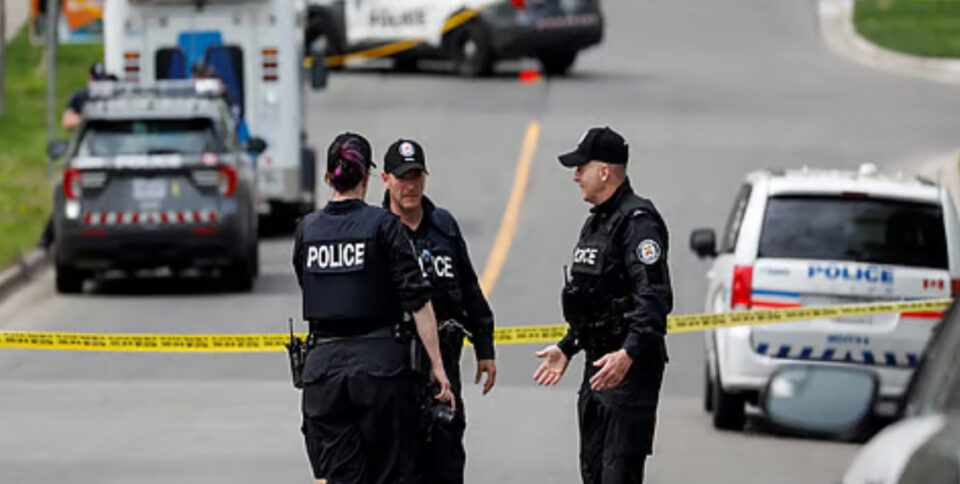
Extortion Terror: South Asian Communities in Canada Living Under Siege
From WhatsApp threats to midnight gunfire, organized extortion networks are instilling fear across immigrant neighborhoods in British Columbia and beyond.
South Asian extortion in Canada: She was asleep in her bedroom when the bullets tore through the walls.
The attack, one of many linked to a widening extortion campaign,
left a woman injured and an entire neighbourhood shaken. For thousands of South Asian families across Canada, this is no longer an isolated act of violence but part of a disturbing pattern: anonymous threats, demands for money, and shootings when those demands are ignored.
What often begins as a WhatsApp call or social media message, ” pay up or face consequences”, can escalate within days. Homes, restaurants, and workplaces are targeted in late-night drive-by shootings designed not necessarily to kill, but to terrorise.
Authorities say the wave is concentrated in British Columbia but is increasingly affecting Alberta and Ontario, provinces with large South Asian populations.
His remarks drew immediate backlash from community members and political leaders, including B.C. Premier David Eby, who warned that downplaying the threat undermines public confidence.
Brewer later apologised, stating that extortion investigations remain a top priority. But for residents living with nightly fear, official terminology matters far less than visible results.
A Transnational Network of Fear
Investigators have linked many threats to criminal networks associated with jailed Indian gangster Lawrence Bishnoi, currently incarcerated in Tihar Jail. Authorities believe operatives abroad coordinate attacks using encrypted communication platforms, enabling violence thousands of kilometers away from the gang’s leadership.
As of mid-January, at least 34 extortion cases involving 21 victims had been reported in British Columbia alone — nearly two incidents per day. Several victims were targeted multiple times.
The Canada Border Services Agencyhas deported some suspects, while more than a hundred foreign nationals remain under investigation. Reports that some individuals have filed refugee claims — allowing them to stay in Canada during legal proceedings — have fuelled frustration within affected communities.
Surrey Mayor Brenda Locke has expressed alarm at the scale of the attacks and the possibility that suspects may be exploiting Canada’s asylum system.
Police have responded with a dedicated tip line and a $250,000 reward fund — one of the largest in Canadian policing history — for information leading to convictions. Yet authorities acknowledge that fear continues to suppress reporting.
Businesses Built by Immigrants Under Attack
Small businesses — restaurants, trucking companies, construction firms, retail stores — are frequent targets. Many are family-run enterprises built over decades by first-generation immigrants.
Even high-profile establishments have not been spared. A café associated with Indian comedian Kapil Sharma in Surrey has reportedly been attacked multiple times.
For entrepreneurs supporting extended families both in Canada and abroad, extortion demands can feel like an impossible dilemma: pay criminals or risk violence against loved ones.
Life on Edge
In neighbourhoods across Surrey and Abbotsford, fear is no longer episodic — it is ambient. What once felt unthinkable has become part of the daily rhythm of life. Residents describe an existence shaped by constant anxiety. Parents keep their children away from front yards and bedroom windows. Families hesitate before answering unknown phone calls, wary that a ringing notification could be another demand for money. Shopkeepers arrive each morning bracing for shattered glass or fresh bullet holes. Employees working late-night shifts flinch at every unfamiliar vehicle that slows near their workplace.
Community leaders say the psychological toll may be as devastating as the physical violence. Sleep is fractured, social life has shrunk, and security measures now dominate household budgets.
Perhaps most troubling is the quiet erosion of trust. Some victims, convinced that arrested suspects will quickly return on bail, choose silence rather than risk retaliation. Others, fearing for their families, have reportedly armed themselves — raising alarms about the potential for vigilante violence and escalating cycles of retribution.
Political Pressure and Federal Response
Premier Eby has discussed the situation with Prime Minister Mark Carney and federal Public Safety Minister Gary Anandasangaree. Ottawa has pledged additional federal police resources and coordinated action across affected provinces.
Community advocates say the response must be swift and visible to restore confidence among residents who feel abandoned.
When Fear Becomes Normal
Canada’s legal framework, grounded in the Charter of Rights and Freedoms, guarantees due process and bail rights for the accused. While these protections are foundational to democracy, many victims fear they also allow suspects to return quickly to the streets.
The perception of a “revolving door” justice system has led some families to quietly pay extortion demands rather than risk further violence — a choice that entrenches criminal networks and deepens community trauma.
What alarms observers most is how routine these incidents have become. Shootings at homes are increasingly treated as background noise rather than extraordinary events. Children grow up under surveillance cameras. Social gatherings shrink. Nightfall brings apprehension rather than rest.
A Test of Canada’s Promise
This is no longer merely a law-enforcement issue. It is a test of political will, institutional effectiveness, and the social contract that promises safety to those who live and work in the country.
For South Asian Canadians — many of whom arrived seeking stability and opportunity — the current wave of extortion strikes at the heart of that promise.
Whether officials call it a crisis or not, the reality on the ground is unmistakable:
An entire community feels under siege — and is waiting for Canada to prove it will not look away.
North America Correspondent and senior journalist based in Canada
Senior Journalist and author, with an experience of around thirty years in media she has actively covered political issues and has been known for her investigative knack and research based work.
1971: A War Story