Courts tailor sentences to protect offenders’ immigration status—while skilled workers are erased by policy with no appeal
Canada’s Justice Paradox: On Jan. 5, 2026, an Ontario court sentenced Rajwinder Singh, a 43-year-old truck driver, to just 55 days in jail for careless driving causing death of a young local woman, Adrianna Milena McCauley.
His sentence also included 24 months of probation with mandatory counselling, a three-year driving suspension, and a $1,000 fine, reduced for his convenience as he had lost his job. Singh had pleaded guilty on Oct. 15, 2025.
A life was lost. The sentence amounted to less than two months behind bars.
That case is not an anomaly.
Leniency in Ontario Courts: A Growing Pattern
In another Ontario decision, Samarpreet Singh, a 23-year-old Bell technician, was convicted of exposing himself to a female customer and making sexually inappropriate remarks.
Instead of incarceration, he received 90 days of house arrest and 12 months’ probation. Defence submissions emphasised that jail time could jeopardise his immigration status—a factor the court explicitly considered.
The ruling sparked public backlash and renewed debate over sentencing discretion. (CTC News)
In yet another case in 2025, an Ontario judge granted a conditional discharge to Akashkumar Narendrakumar Khant, an Indian national convicted of attempting to purchase sex from an undercover police officer posing as a 15-year-old girl.
No jail time.
No criminal record.
Crown prosecutors did not appeal.
Avoiding Deportation, Preserving Status
The court accepted arguments that a conviction would:
-
Delay Canadian citizenship by four years
-
Jeopardise permanent resident status
-
Prevent family sponsorship
-
Block professional engineering licensure

Sain Network has already covered the cases of Gaganpreet Singh and Jagdeep Singh, two international students convicted in 2025 of a serious violent crime resulting in death, who received a three-year sentence—structured specifically so they could remain in Canada.
Not Isolated Rulings—A Systemic Practice
These decisions have not gone unnoticed.
During House of Commons debates, lawmakers cited further examples, including:
-
A non-citizen convicted of fraud receiving a shortened sentence to avoid deportation
-
A refugee convicted of assaulting police receiving a reduced term to preserve immigration status
These cases were raised during discussions on proposed legislation that would bar courts from considering immigration status in sentencing altogether.
That bill is still on the table, but not yet enacted.
While Criminals Stay, Skilled Immigrants Are Shown the Door
While individuals with criminal convictions remain in Canada through carefully calibrated sentencing thresholds, another group—law-abiding skilled immigrants—is being pushed out.

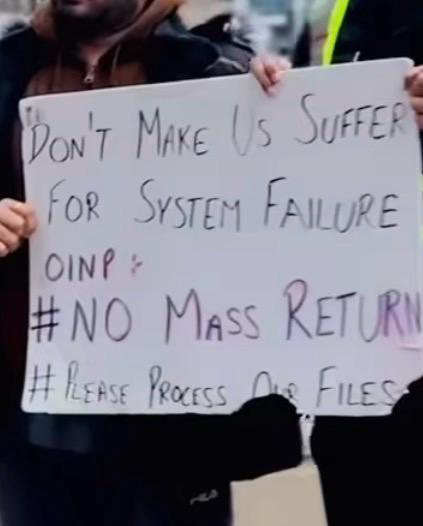
Immigrants who entered Canada through the Ontario Immigrant Nominee Program (OINP) Express Entry Skilled Trades Stream are now losing their status en mass, simply due to a change in government policy.
Launched in 2007, the program was designed to address labour shortages by offering pathways to permanent residency for skilled workers, international graduates, and entrepreneurs. Nearly 100,000 people are estimated to have relied on this program to build lives in Ontario.
Late last year, Ontario abruptly:
-
Suspended the stream
-
Stopped accepting new applications
-
Returned all pending files without review, appeal, or timeline for reinstatement
A Stroke of the Pen, Lives Upended
The explanation offered was that during a review, OINP identified “systemic compliance and enforcement concerns.” Yet no individual fraud was identified.
With a single administrative decision—a stroke of Premier Doug Ford’s pen—futures were erased.
Work permits are expiring.
Families face separation.
Careers built over years are collapsing overnight.
Many of these workers have lived in Canada from 1 to 7 years or more. Their children were born in Canada, know no other country, language, or life—and now face uncertainty.
Protesting in –20°C, Begging for Due Process
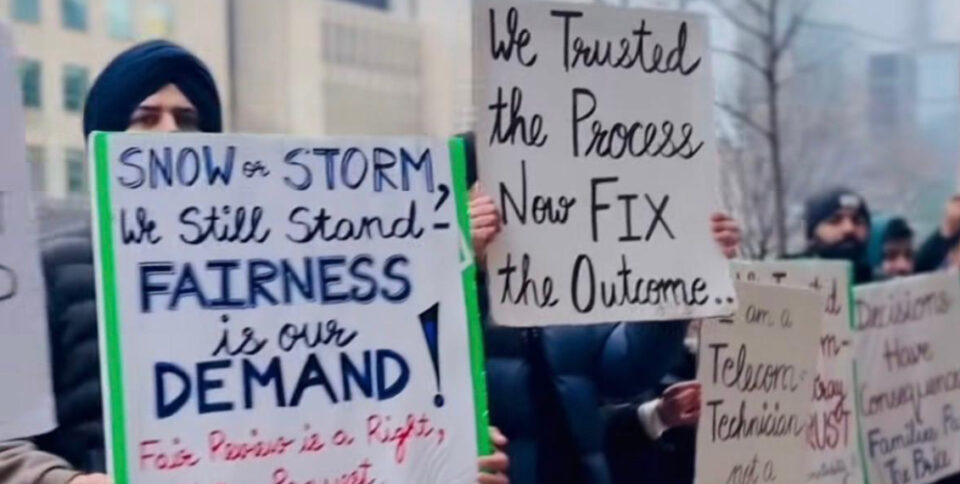
These workers—many with no criminal records—are protesting in –20°C weather across Ontario, pleading for their applications to be reviewed.
Several young women and children have reportedly been hospitalised due to extreme cold exposure.
They are taxpayers.
They are essential workers.
They are contributors.
And they are being discarded like waste paper.
Why Criminals Stay and Workers Are Forced Out
So why are criminals allowed to stay while law-abiding, working-class people are shunted out?
The disparity lies in how the law is structured.
Under Section 36 of the Immigration and Refugee Protection Act (IRPA), permanent residents become inadmissible only if:

-
The offence carries a maximum sentence of 10 years or more, or
-
The individual receives a sentence exceeding six months
Judges know this. And sentencing decisions increasingly reflect that awareness.
The Supreme Court Opened the Door
Judges are bound by stare decisis, the legal doctrine requiring courts to follow precedent.
It was the Supreme Court of Canada that opened this door in R v Pham (2013).
Pham, a permanent resident, received a two-year sentence that triggered deportation without appeal. On review, the sentence was reduced to two years minus one day, preserving his right to challenge removal.
The Supreme Court upheld the reduction, confirming that collateral consequences—including immigration outcomes—may be considered in sentencing.
The Court cautioned against undue leniency.
But the door was left open.
Today, that door is wider than ever.
Policy Without Protection
By contrast, immigration programs like OINP are discretionary policy tools, not protected by statutory due process.
They can be suspended without hearings, without appeals, and without accountability.
This legal imbalance explains why some judges meticulously tailor sentences to avoid deportation for offenders—while provinces can summarily erase pathways for compliant, tax-paying skilled workers.
A National Reckoning
Canada now finds itself in a moral paradox.
One group stands before judges in warm courtrooms, protected by legal nuance.
The other stands outside in –20°C, holding placards, losing hope.
This is not just a legal inconsistency.
It is a national reckoning.
When justice bends to protect offenders but policy crushes workers, the question is no longer how the system works-
but who the system is really working for.