

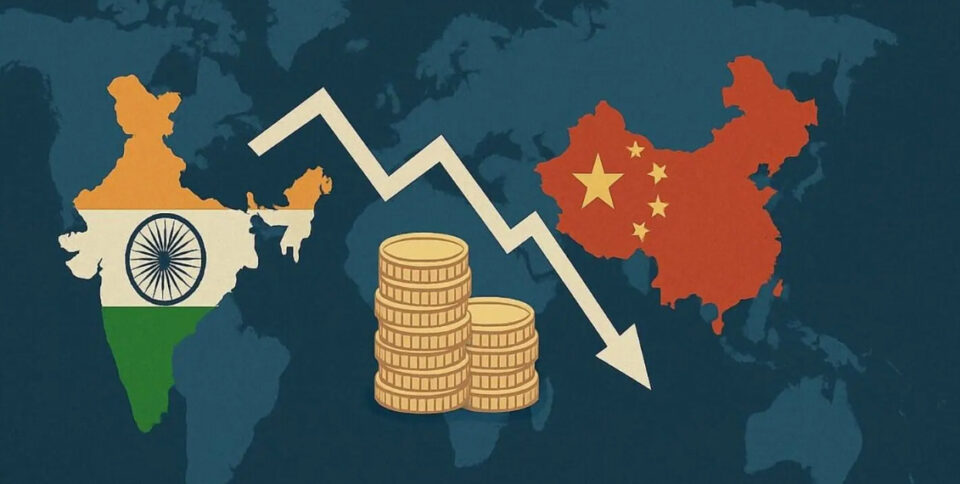
Why the India–China trade gap matters for the Indian economy?
Indian exports to China:The rise in India’s exports to China in 2025 comes at a critical moment for the Indian economy, as New Delhi seeks to rebalance trade ties with its largest import partner amid slowing global demand and geopolitical uncertainty.
While Indian exports to China grew by USD 5.5 billion year-on-year, the overall trade deficit expanded to a record USD 116.12 billion, underscoring the persistent structural gap between the Indian economy and the Chinese economy.
Export gains offer limited relief
Economists say the export growth is significant because China has historically been a difficult market for Indian products. The increase suggests incremental improvements in market access and competitiveness for Indian goods, providing a marginal boost to the Indian economy.
However, in relative terms, India’s exports remain small compared to China’s scale. With exports of USD 19.75 billion against imports exceeding USD 135 billion, the Indian economy continues to run one of its largest bilateral trade deficits with any country.
Structural contrast between two economies
The widening trade gap highlights the fundamental differences between the Indian economy and the Chinese economy. China’s exports to India are dominated by high-value manufactured goods such as electronics, machinery, power equipment and chemicals. In contrast, Indian exports to China are largely concentrated in raw materials, minerals and low-value intermediate goods.
This difference reflects China’s advanced manufacturing ecosystem and integrated supply chains, while the Indian economy remains in a transition phase, still building scale in manufacturing despite policy efforts such as the Production-Linked Incentive (PLI) schemes.
Dependence on Chinese imports
For the Indian economy, the record trade deficit also signals continued dependence on Chinese inputs across key sectors, including pharmaceuticals, renewable energy, electronics and infrastructure. Analysts note that even as India pushes for self-reliance, Chinese imports remain critical for sustaining domestic production and growth.
This dependence adds urgency to India’s efforts to diversify supply chains, strengthen domestic manufacturing and reduce vulnerabilities linked to external shocks.
Implications for policy and growth
The latest trade data is expected to influence policy discussions in New Delhi, particularly around industrial strategy, export competitiveness and import substitution. Policymakers see sustained export growth to China as essential if the Indian economy is to narrow the trade gap and improve its position in regional value chains.
At the same time, the figures underline a broader reality: economic engagement between India and China continues to deepen despite political tensions. For the Indian economy, converting export gains into long-term competitiveness will be key to reshaping the balance of trade with Asia’s largest economy.